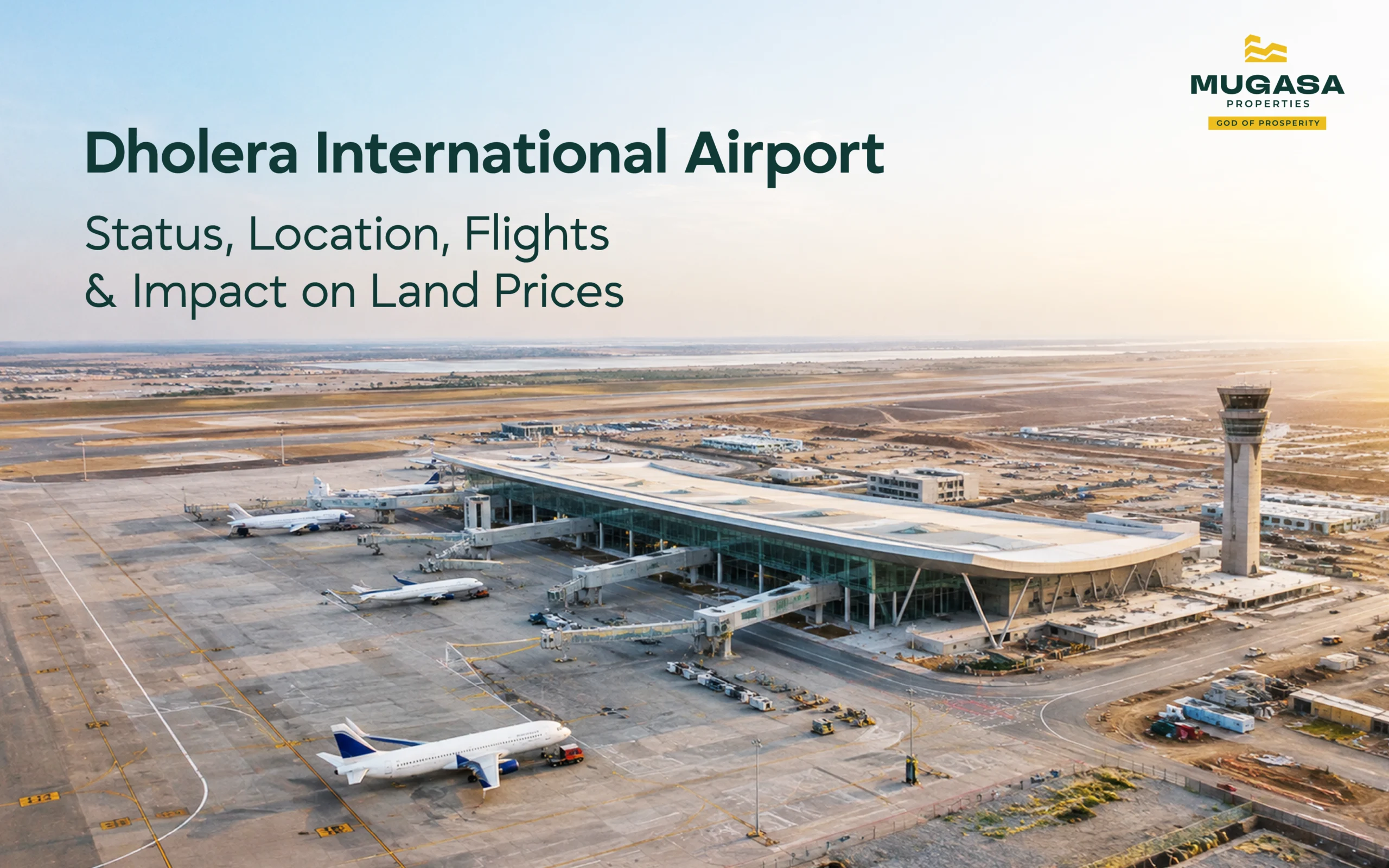


Airports do not just move passengers. They move money.
Every serious city in the world understood this at some point in its development. Hyderabad figured it out when Shamshabad opened in 2008 and the surrounding corridor spent the next decade turning farmland into one of South India’s most active real estate belts. Jewar figured it out before a single flight landed, with land along the Yamuna Expressway corridor tripling in value in the five years between announcement and inauguration. Navi Mumbai figured it out and Panvel has not been the same since.
Dholera is next. And the airport is closer to operational than most people following dholera airport news currently appreciate.
|
Factor |
Detail |
|
Location |
Near Navagam village, Ahmedabad district, Gujarat |
|
Distance from Dholera SIR |
Approximately 20 to 25 km from Activation Area |
|
Distance from Ahmedabad |
Approximately 100 km |
|
Land Area |
1,426 hectares |
|
Phase 1 Project Cost |
Rs 1,305 crore |
|
Phase 1 Runway |
3,200 metres, Code 4E, wide-body capable |
|
Phase 2 Runway |
4,000 metres, under development |
|
Aerocity |
75 hectares of commercial development planned |
|
Developer |
Dholera International Airport Company Limited (DIACL) |
|
Owner |
Airports Authority of India |
|
Phase 1 Target |
Late 2026 |
|
Primary Focus |
Cargo first, passenger operations to follow |
Near Navagam village in Ahmedabad district. That is the specific answer to the Dholera international airport location question that most articles skip over in favour of vague references to Gujarat or the DMIC corridor.
Navagam puts the airport roughly 20 to 25 km from the Dholera SIR Activation Area. Worth understanding why that gap exists: the airport was never meant to sit inside the city boundary. It sits on the expressway corridor that feeds into the city, which is a deliberate logistics decision. Cargo and passengers reach the facility directly off the Ahmedabad-Dholera Expressway without touching any of Dholera’s internal road network. That keeps industrial and city traffic separated from the start, something most Indian cities only attempt to fix after the congestion has already happened.
|
Origin |
Distance to Airport |
|
Ahmedabad |
Approx 100 km |
|
Surat |
Approx 280 km |
|
Bhavnagar |
Approx 80 km |
|
Zone 2, Dholera SIR |
20 to 25 km |
|
Zone 4, Dholera SIR |
25 to 30 km |
|
Zone 6, Dholera SIR |
30 to 35 km |
Zone 2 holds the clearest proximity advantage here. That matters considerably for what land near the dholera airport estate commands today versus what it will command once cargo operations go live.
According to ground-level reporting from early 2026, Phase 1 construction wrapped up in December 2025 and the airport moved into licensing, calibration, and operational trial stages through the first quarter of 2026.
The 3,200-metre Code 4E runway is ready. That specification handles Boeing 777s and Airbus A330 family aircraft without restriction. Worth saying plainly: this was not built as a regional strip for turboprops. The runway was engineered for international cargo and long-haul passenger operations from day one, with the capacity to grow into that demand as industrial activity in the SIR scales.
As confirmed by multiple site updates, the passenger terminal structure is complete, the Air Traffic Control tower has been built, and the cargo handling facility is in place. What the airport is working through currently is the regulatory and calibration phase that every new facility of this scale goes through before formal operations begin.
A second runway at 4,000 metres is under development. The aerocity covering 75 hectares of commercial land sits in the Phase 2 plan alongside maintenance, repair and overhaul facilities and expanded cargo infrastructure. Phase 2 tracks industrial occupancy in the surrounding zones and does not yet have a confirmed date tied to it.
Dholera International Airport Company Limited (DIACL) operates the project under the Airports Authority of India. The Cabinet Committee on Economic Affairs approved Phase 1 at Rs 1,305 crore with a 48-month delivery window. State and central government coordination runs through DICDL, the same SPV managing the broader Dholera SIR development. Environmental clearances are in place. Land acquisition for the airport site is complete.
As reported by aviation infrastructure trackers covering the project, the cargo terminal is targeting international and domestic cargo traffic by late 2026. Passenger flights follow after that, with a timeline tied to airline scheduling, DGCA approvals, and terminal readiness sign-offs.
The realistic picture for investors: cargo operations in late 2026 is the near-term milestone. Scheduled passenger services, domestic and international, are more likely a 2027 to 2028 story. That does not weaken the land value argument at all. The period before full passenger operations is historically where the steepest early appreciation happens, as both Jewar and Shamshabad demonstrated with documented consistency.
For the full Dholera development status report, including how the airport fits alongside the semiconductor plant, expressway, and zone activations, that broader context matters.
Most airports in India were designed for passengers and retrofitted cargo later. Dholera’s sequencing runs the other way around entirely. Cargo terminal readiness arriving ahead of scheduled passenger services reflects the industrial logic of the city being built around it.
Tata Electronics is constructing India’s first semiconductor fabrication facility here. ReNew Power has a solar manufacturing plant in the Activation Area. Polycab, Hindustan Petroleum, and Vedanta are already on the ground. What these operations require above everything else is reliable, high-capacity cargo movement: components arriving, finished product leaving. Passenger flights help. Cargo infrastructure at this scale is essential to the entire industrial model.
The dholera smart city airport does not stand alone in the logistics picture. It sits at the northern end of a corridor that runs south toward Bhavnagar’s port, east on the expressway to Ahmedabad, and eventually connects to the Dedicated Freight Corridor via the Bhimnath-Dholera rail link currently in planning. Road, rail, air, and port in a single corridor is not a common configuration for an Indian city at this stage of development. Dholera airport city was built into a logistics grid, not dropped onto a map after the city was already planned.
Sardar Vallabhbhai Patel International Airport in Ahmedabad operates at or near capacity during peak periods. Dholera is positioned to absorb cargo overflow from Ahmedabad while building its own industrial-focused traffic base from the semiconductor and manufacturing operations already confirmed in the SIR. The two airports serve fundamentally different primary demand pools. Ahmedabad handles passenger-dominated commercial traffic. Dholera handles industrial cargo with passenger services building behind it on a longer timeline.
The pattern across Indian airports is documented and consistent. Look at the record rather than the projections.
As reported by real estate research platforms covering the Jewar corridor, land prices surrounding the Noida International Airport rose by 200% to 400% in zones closest to the airport boundary from the time construction began. Early investors who bought agricultural and residential land in 2019 and 2020 are sitting on multiples today that were not projected in the initial analyses.
In Hyderabad, according to The Hans India’s property analysis, land near Shamshabad cost roughly Rs 500 per square yard in the year 2000 before the airport came. The same corridor now commands Rs 55,000 to Rs 60,000 per square yard in active zones. A corridor that most people in Hyderabad once considered distant became one of the city’s most sought-after belts within a decade of the airport opening.
The 5 to 10 km radius from an airport boundary historically captures the first and steepest appreciation wave. The 10 to 25 km radius follows once first-wave pricing pushes buyers outward. Beyond 25 km, appreciation is real but paced more by general city growth than airport-specific demand.
In Dholera’s case, Zone 2’s Activation Area sits 20 to 25 km from the airport site. That positions it at the outer edge of the first appreciation radius, which is a meaningful observation for investors currently studying how Dholera land prices have moved since 2010.
Zone 2 carries the clearest airport proximity advantage at 20 to 25 km from Navagam. It also holds the most developed infrastructure in the SIR, which means land here prices both the proximity premium and the infrastructure premium at once. Zone 4 sits 25 to 30 km out and offers a growth-stage entry with a 2 to 3-year horizon before airport-driven demand reaches its full weight there. Zone 6 at 30 to 35 km provides the lowest entry pricing in the active zones with the longest appreciation horizon ahead of it.
According to Estate Bull’s research on airport-proximate real estate, land prices near Jewar Airport saw a 450% surge over five years along the Yamuna Expressway, alongside a 170% rise in apartment values in the same period. The Anarock Report tracking NCR residential markets documented a 92% price surge in Noida and 98% in Greater Noida between Q1 2020 and Q1 2025, with the Yamuna Expressway corridor recording approximately 3x appreciation in the same window.
As reported by Star Estate’s 2026 Airport Effect analysis, Hyderabad’s Shamshabad corridor recorded more than double the property price appreciation over five years, driven by the airport alongside the Pharma City, aerospace parks, and the metro line now under planning.
Dholera sits in a structurally stronger position than any of those three corridors at equivalent stages. Those appreciations were largely anticipation-driven. Dholera’s is being driven by confirmed industrial anchors already operating alongside an airport approaching commissioning. The combination compresses the typical gap between announcement and price response.
Proximity to an airport is a legitimate value driver. It is also one of the most consistently misrepresented selling points in Indian real estate. Here is what actually needs verification before any transaction happens.
Zone and TP scheme classification. A plot described as airport-adjacent means little if it sits in a zone that restricts the development you are planning. Verify the exact TP scheme and permitted land use before anything else.
Legal title and documentation. Title disputes in villages surrounding Dholera exist. Any plot sold on the basis of airport proximity needs clean title, verified NA status, and clear documentation from an advisor with actual ground presence in the SIR.
Actual distance from the airport boundary. Marketing material uses “near the airport” for anything from 3 km to 35 km away. Get the coordinates and measure it against the Navagam site location yourself.
Who is guiding the transaction. Airport-adjacent land attracts the highest concentration of unreliable intermediaries in any developing Indian city. The advisor matters as much as the plot in this specific segment.
At Mugasa Properties, 20 years of work in Dholera means every plot we present has been physically visited, legally verified, and assessed against long-term appreciation fundamentals by people who have walked the ground. If you want to look at plots in the zones nearest the airport with complete documentation behind them, that conversation starts with us.
Is Dholera International Airport operational in 2026?
Runway and core Phase 1 infrastructure are ready. Cargo operations are targeting late 2026. Passenger flights come after that.
How far is Dholera Airport from Ahmedabad?
Around 100 km by road. Via the expressway, under an hour from Sarkhej.
How much does land near Dholera airport cost?
Pricing varies by zone and TP scheme. Get current verified figures directly from Mugasa Properties before relying on anything you read online.
Will Dholera airport handle international passenger flights?
Yes, it is designed and approved for international passenger operations. Cargo comes first and international passenger services follow as industrial demand builds the traffic base.
Which Dholera zone is closest to the airport?
Zone 2. At 20 to 25 km from Navagam, it carries both the proximity premium and the infrastructure advantage of the most developed zone in the SIR.
Three airports changed everything around them permanently.
Shamshabad turned a forgotten southern stretch of Hyderabad into real estate that serious buyers now compete for. Jewar rewrote valuations along the Yamuna Expressway corridor before the first IndiGo flight touched down in June 2026. Navi Mumbai airport gave Panvel and Ulwe a growth story they would have waited another decade for otherwise.
Dholera sits in a stronger position than any of those three at equivalent stages because the airport is arriving into a city that already has confirmed industrial anchors, an operational expressway, and government ownership that removes abandonment risk entirely.
The investors who look back on 2026 with clarity will mostly be the ones who stopped waiting for the first flight announcement and moved when the runway was already standing.
That runway is standing right now.
Book a free consultation with our team to discuss how Dholera fits your investment portfolio.
Book a ConsultationShare this article:

October 2026

October 2026
October 2026
Share your details and our team will call you with current availability and guidance.