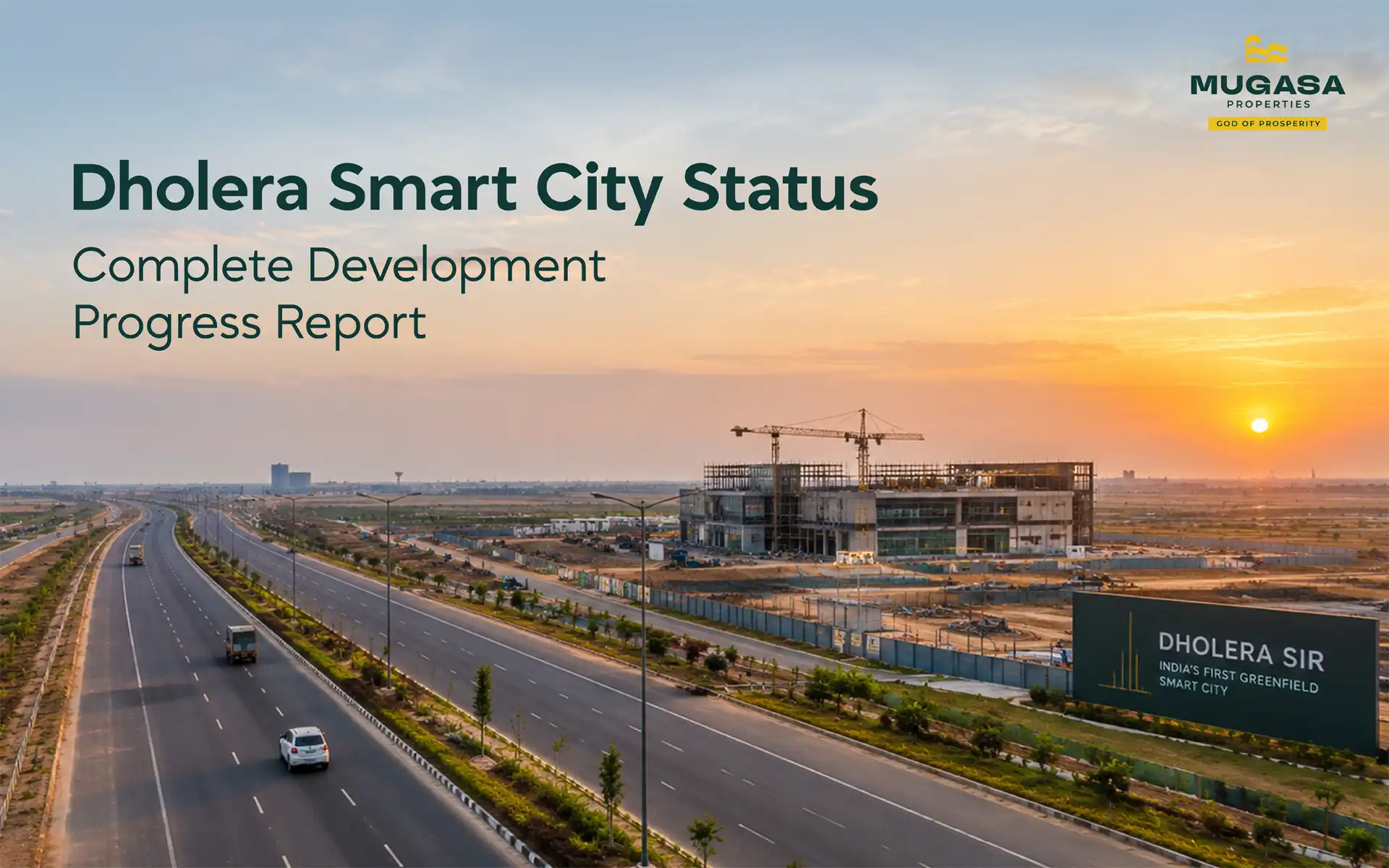


If you have been tracking Dholera for a while, you already know the standard narrative. Government vision. Long timeline. Ambitious master plan. We have all heard it.
What is different in 2026 is that the narrative is no longer about what Dholera will become. It is about what Dholera already is. The city has transitioned from the construction phase to the operational phase, making it no longer just a blueprint, but a functional industrial ecosystem. That shift matters more than most people currently appreciate.
This report covers what is actually on the ground, what is still coming, and what serious investors should be watching over the next 12 months.
Before getting into the details, here is the project at a factual level.
| Factor | Details |
| Total Area | 920 sq. km across 22 villages |
| Ownership Structure | 49% Government of India via NICDC / NICDIT, 51% Government of Gujarat via DSIRDA |
| Implementing Body | DICDL – Dholera Industrial City Development Limited |
| Town Planning Schemes | 6 TP schemes across active zones |
| Activation Area | 22.5 sq. km, Phase 1 |
| Phase 1 Infrastructure Status | 95%+ complete |
| Construction Permitted | Zones 2, 4, and 6 currently active |
| Committed Private Investment | Rs. 1.5 lakh crore+ |
| Master Plan Timeline | 2010 to 2040 |
The ownership structure deserves a specific mention here because it is the one detail that separates Dholera from every other real estate opportunity in India. This is not a private developer’s project where completion depends on sales velocity. The State Government of Gujarat has created a Special-Purpose Vehicle named DICDL, along with the central government’s NICDC Trust, responsible for implementing the project. When two governments share equity, abandonment is not an option. It is a sunk cost neither side can afford to write off. Dholera Prime
This is the section most progress reports get wrong. They either oversell completed work or dismiss the whole project as still theoretical. Neither is accurate.
Dholera SIR has developed a modern internal road network of around 72 km with road widths ranging from 18 metres to 70 metres, supported by underground utility corridors for essential services such as water, gas, and ICT.
The Central Spine Road, a 250-metre wide road connecting the entire SIR, is 100% operational with smart street lighting and sensors fully integrated. To understand the scale of that: 250 metres wide. Most expressways in India are 60 to 90 metres. This was not built to handle current traffic. It was built to handle the traffic of a city that is still being built around it. Luxoria Group
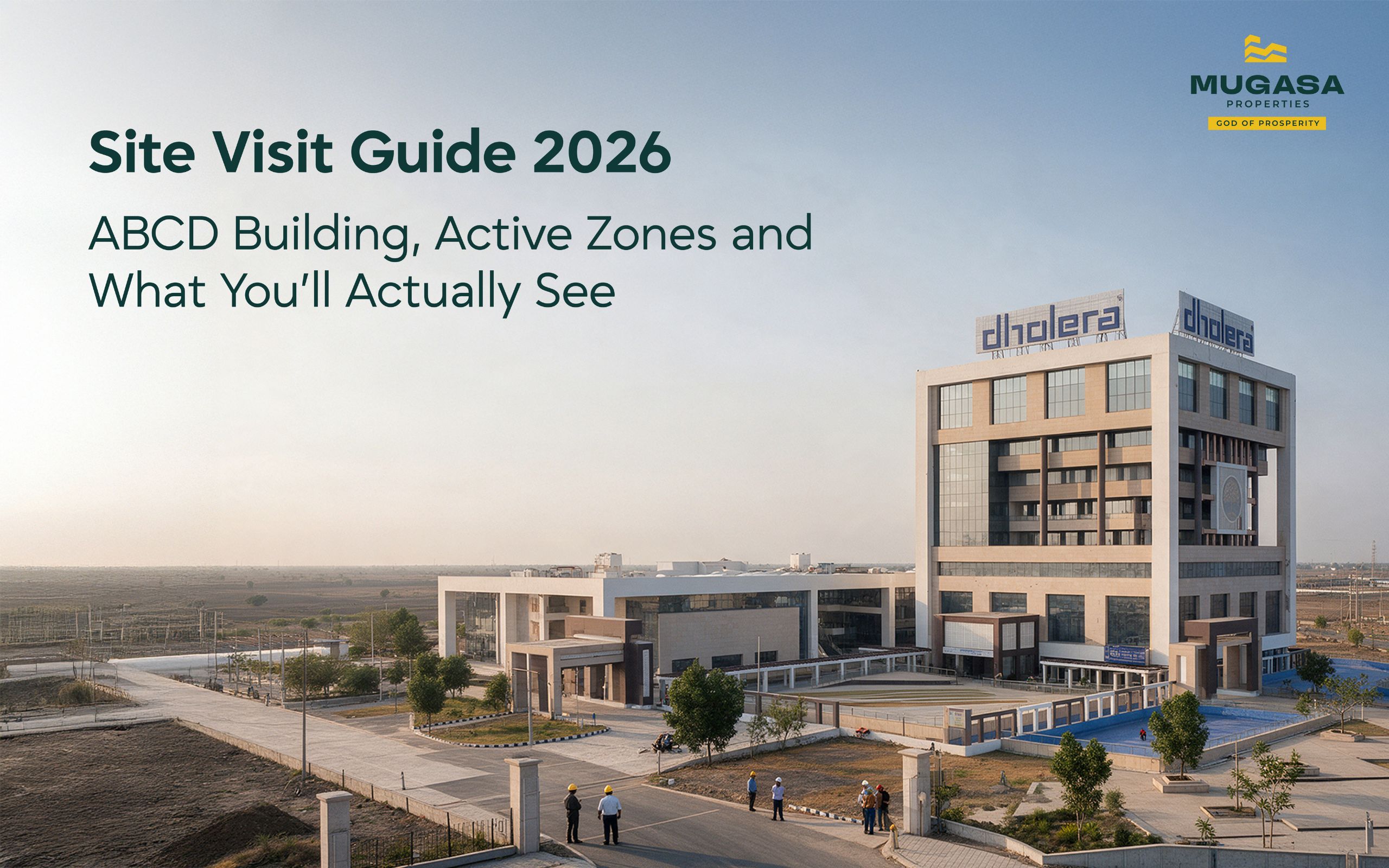
The Administration and Business Centre for Dholera sits in the TP2 Knowledge and IT Zone and spans 36,000 sq. m. It is the physical headquarters of the city’s governance and its nervous system simultaneously.
The ABCD Building supports project administration and showcases Dholera’s smart city vision through modern facilities such as the City Integrated Operations Centre, Experience Zone, auditorium, banquet space, restaurant facilities, and dedicated offices for DSIR administration.
A 24/7 monitoring room where cameras, traffic sensors, and IoT devices feed information on roads, air quality, water networks, and power grids. In emergencies, ICT and SCADA sensors across town automatically alert operators in the ABCD Building, triggering coordinated responses. Dholera Properties
It houses the Single-Window Clearance mechanism, allowing developers and industries to get approvals online within days. That last point is not a minor administrative convenience. Single-window clearance in the Indian infrastructure context is genuinely rare. It removes the bureaucratic friction that has historically slowed industrial land uptake across the country.
Inside the Activation Area, the built utilities include underground power, ICT, gas and water ducts, potable water with smart meters, a recycled-water network, a stormwater canal, a roughly 50 MLD water plant, and about 72 km of roads. Dholera World
The water source is the Narmada canal system, which is government-committed, not dependent on rainfall or local aquifers. All utility lines including high-voltage electrical cables, municipal potable water lines, industrial gas pipelines, and a high-speed fibre optic network are completely buried underground. No hanging wires. No torn-up roads to lay cables later. This infrastructure-first approach is precisely what distinguishes a genuinely planned city from one that merely calls itself smart. Dholera smart city
Tata Power and Torrent Power supply the entire SIR through substations with three-level redundancy. Power costs in Dholera are reportedly 40% cheaper than competing states including Maharashtra, Tamil Nadu, and Andhra Pradesh, with an additional Rs. 2 per unit subsidy for semiconductor and electronics projects. Smart dashboards inside the ABCD Building track power generation from the 1,000 MW Solar Park. The full 5,000 MW renewable energy target makes Dholera one of the few cities in the world designed for 100% renewable-powered operations from inception.
The Airport Authority of India has already conducted a successful trial aircraft landing on the Dholera runway. Two runways are planned at 3,200 metres and 4,000 metres, with a 75-hectare aerocity and full cargo facilities. Cargo operations are expected to begin by late 2026, followed by passenger flights.
For context on why this matters beyond passenger convenience: an international airport with dedicated cargo terminals transforms Dholera from an industrial city into a logistics hub. That is a fundamentally different asset class for the land around it. You can read a more detailed breakdown of the Dholera International Airport status separately.
The Ahmedabad-Dholera Expressway remains one of the most important connectivity projects for the region, with faster connectivity helping investors, industries, homebuyers, logistics companies, and daily travellers. The expressway opened in March 2026, reducing Ahmedabad to Dholera travel time to under 45 minutes. A Cabinet-approved semi high-speed rail corridor at Rs. 20,667 crore is underway. Port access to Mundra, Pipavav, and Kandla is available. Details on the Ahmedabad-Dholera Expressway are covered in full separately. Dholeraacres
This is the single most consequential private commitment in Dholera’s history. The Tata-PSMC fab’s massive structural work is complete. Cleanroom installation and machinery move-in have started. Over 15 supply-chain companies, including Japanese and Taiwanese firms, have started land leveling for their units near the Tata site. Over 5,000 workers and engineers are currently active on-site in the industrial zones.
Rs. 91,000 crore. India’s first semiconductor fabrication facility. When this plant reaches full production, Dholera does not just become an industrial city. It becomes a node in the global semiconductor supply chain. That is a different category of anchor entirely. A full breakdown of Tata’s semiconductor fab and its implications is available separately.
ReNew Power, one of India’s largest renewable energy companies, has committed to a solar manufacturing plant within the Activation Area. Industrial allotments have been made to companies like Tata Power Solar, ReNew Power, Hitachi Hi-Rel, and Torrent Gas, according to DICDL. Thehanudhara
This is where investors need to be careful. Dholera has attracted genuine commitments and promotional noise in roughly equal measure. The distinction that matters is between companies that have received formal plot allotments and commenced ground activity versus those that have signed MoUs or made press announcements.
Confirmed on-ground presence includes Tata Electronics, Tata Power Solar, ReNew Power, Torrent Power, Hitachi Hi-Rel, Hindustan Petroleum Corporation, Polycab India, and Vedanta Group. MoUs and intent letters exist from additional names, but until ground activity is confirmed, they should be treated as directional signals rather than certainties.
To understand how Dholera’s zones and TP schemes work, it helps to know why development is structured this way in the first place.
Dholera’s 920 sq. km is divided with intention. The master plan designates construction across approximately 35% of the total area. The remaining 65% is preserved as green corridors, agricultural land, coastal regulation zones, and buffer areas. This is not a limitation. It is deliberate planning that keeps the city’s density manageable and its land values structurally protected over time.
Zone 2 – Activation Area: Roads, water, electricity, and all operational infrastructure are in place. Closest to the airport and the Tata semiconductor plant. Infrastructure completion at 95%+. This is where most verified private investment activity is currently concentrated.
Zone 4 – Growth Zone: Active infrastructure development. Road network approximately 70% complete. Suited for a 2 to 3-year investment horizon.
Zone 6 – Entry Zone: Early-stage development with utility corridors under construction. Lowest entry pricing in the active zones. Highest upside potential for investors with a 3 to 5-year horizon.
If you are looking at plots currently available in Zone 2, 4, and 6, the key variable is not just the zone but the specific TP scheme within the zone and its proximity to confirmed industrial anchors.
Dholera Smart City Phase 1 is almost 95% complete with roads, power, water, and the ABCD command centre ready. Phase 1 is expected to be fully operational by 2025 to 2026. By most visible measures, that target has effectively been met in the Activation Area. Dholeraacres
Phase 2 covers the broader industrial and residential expansion zones beyond the 22.5 sq. km Activation Area. The projected window for meaningful Phase 2 progress runs through 2028 to 2030, contingent on industrial occupancy rates in the Activation Area driving demand for adjacent zones.
Phase 3, covering full city-scale development including the residential corridors and complete metro connectivity, has a horizon out to 2035 to 2040 under the original master plan.
Dholera has already experienced its primary delay: the 2014 to 2019 period where political uncertainty around the joint central-state ownership structure slowed funding and clearances. That structural risk has been resolved. The 49% central government equity stake now means continuity regardless of state-level political changes.
The realistic remaining risks are timeline extensions on the airport and semiconductor plant, both of which involve global supply chains and specialized construction. These delays, if they occur, would affect when appreciation accelerates, not whether it does.
Honest answer: not yet, for residential purposes at scale. The Activation Area has operational infrastructure, the ABCD Building, and industrial activity. The Gujarat government is actively working to strengthen Dholera’s social infrastructure, including a multispeciality hospital, school, fire station, food court, guest house, tent city, and residential and commercial developments.
For residential living at any meaningful quality of life, Dholera needs its airport operational, its food and retail ecosystem built out, and its semi-high-speed rail link to Ahmedabad completed. That is a realistic 2 to 4-year window from now.
For industrial operations and investment land purposes, the infrastructure is already sufficient. That distinction matters enormously when evaluating the timing of a land purchase.
Dholera’s land market has tended to respond to visible development milestones, rather than announcements alone. The pattern is useful because it shows what has mattered in the past and what investors should watch next.
2023 – Tata Semiconductor Announcement
One of the clearest examples came with Tata Electronics’ semiconductor announcement. In TP2, land prices reportedly moved from around ₹2,800 to ₹32,000 per sq. yard following confirmation of the project.
The lesson was straightforward: when a major industrial commitment becomes tangible, land closest to the development can reprice quickly.
2026 – Ahmedabad–Dholera Expressway Opens
The expressway moved connectivity from an announced infrastructure project to an operational one. This is an important distinction for investors: a completed road changes accessibility today, rather than promising better connectivity at some point in the future.
2026 – Dholera Airport Moves Towards Operations
The next major signal is the airport moving from construction into actual operations. The runway and taxiway are already complete, while terminal works continue.
Cargo operations and the confirmation of an operational date would be the next milestone worth watching, particularly for land positioned around the airport and logistics ecosystem.
The proposed Ahmedabad–Dholera semi-high-speed rail corridor and the wider freight-rail network represent the next layer of connectivity.
Cabinet approval, land acquisition, construction milestones and, eventually, commissioning will each provide a progressively stronger indication that Dholera’s multimodal network is taking shape.
Next Phase – Industrial Allotments & Construction
The next meaningful signal may come from the industrial side.
Watch for announced companies moving through the sequence:
MoU → formal allotment → construction → operations.
That progression matters more than the headline announcement itself. As additional industrial projects move into construction and production, demand for supporting manufacturing, logistics and commercial activity can broaden beyond the current core.
What is the current status of Dholera Smart City in 2026?
The activation area’s trunk infrastructure is fully operational. Major milestones, including the international airport’s runway completion and the Ahmedabad-Dholera expressway, are now driving the next phase of development. The city has transitioned from construction to early operational status in the Activation Area. Pr3-articles
When will Dholera Smart City be completed?
Phase 1 of the Activation Area is effectively complete as of 2026. Phase 2 industrial and residential expansion is projected through 2028 to 2030. Full city-scale development under the master plan runs through 2035 to 2040.
Is Dholera Smart City ready to live in right now?
For residential living at scale, no. The essential civic infrastructure is under development. For industrial operations and land investment, the Activation Area is fully functional. Residential readiness at quality scale is a 2 to 4-year window from today.
Which zones in Dholera are currently open for development?
Zones 2, 4, and 6 are currently active for construction and investment. Zone 2 is the most developed. Zones 4 and 6 offer growth and entry-stage pricing respectively.
Has Dholera Smart City failed, or is it genuinely progressing?
This is real, checkable progress, not just marketing. The Activation Area is mostly built. The Tata-PSMC semiconductor fab is under construction. The expressway works. AAI has landed a test aircraft on the airport runway. The Union Cabinet has approved and funded a semi-high-speed rail line to Ahmedabad. Dholera has not failed. It has been slower than originally projected, and it is now accelerating.
Dholera is not a story that rewards impatience. It never was. It is a 30-year master plan for a city the size of Mumbai, backed by two governments and anchored by some of the largest industrial commitments in India’s recent economic history.
What 2026 represents is an inflection point. The infrastructure that typically takes 20 years to build organically in an Indian city already exists in the Activation Area. The industrial anchors that drive land value appreciation are already on the ground and building. The connectivity infrastructure that makes a city usable is either complete or within a 12 to 24-month window of completion.
The investors who will look back on 2026 as the moment they moved are the ones who understood that the gap between promise and proof had already closed, and that the only thing left was timing.
Mugasa Properties has been advising investors on Dholera land since before the expressway existed. Every plot we represent has been personally visited, verified, and assessed by our team. If you want to understand where the right land is within this city right now, speak with us directly. We will tell you what we know, including the parts that do not make it into most progress reports.
Book a free consultation with our team to discuss how Dholera fits your investment portfolio.
Book a ConsultationShare this article:
October 2026
October 2026
October 2026
Share your details and our team will call you with current availability and guidance.