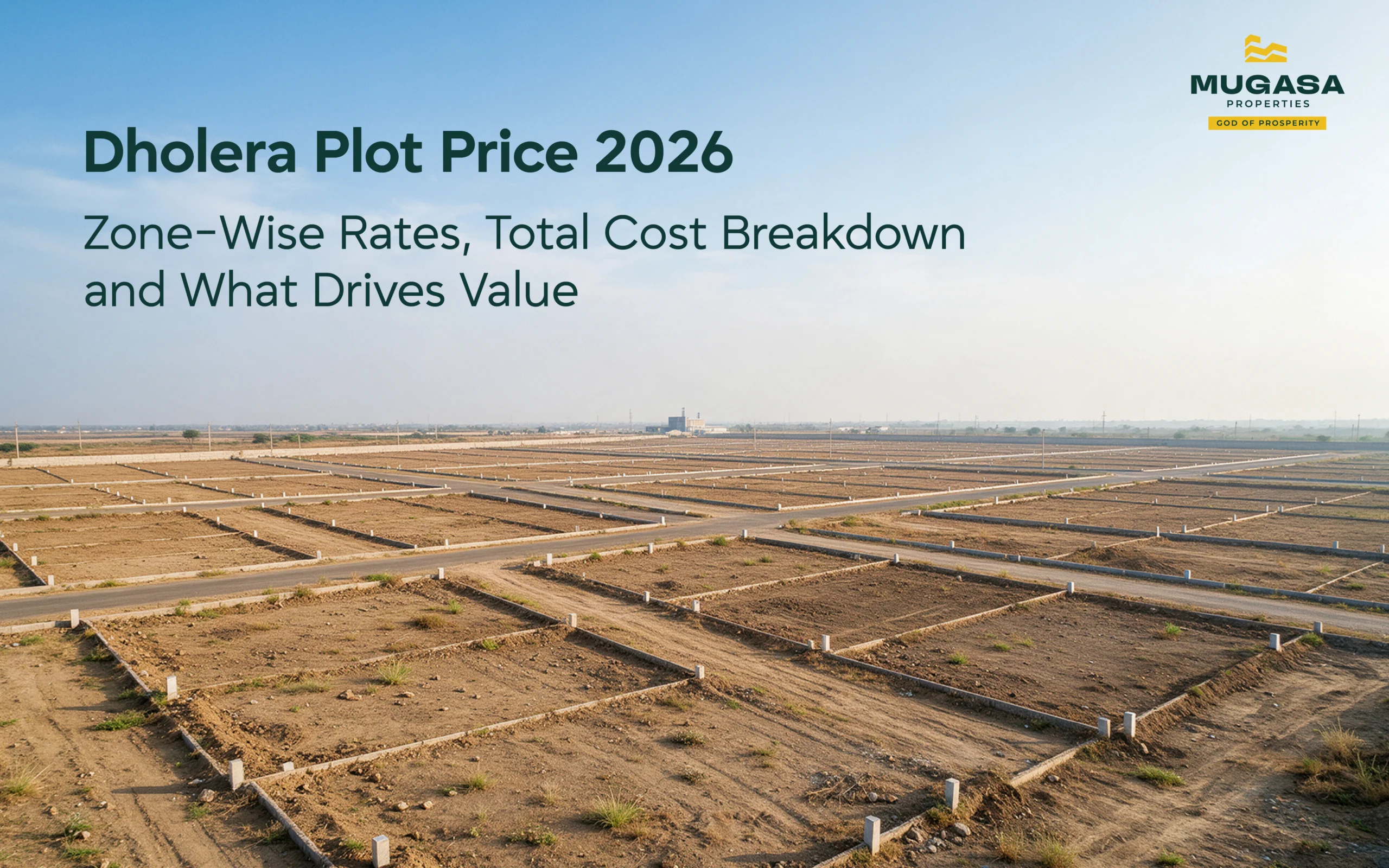


Search for Dholera plot prices and you will find twenty different numbers before you find one honest explanation. Some sellers quote one figure. Others quote something three times higher. Both are technically accurate for different plots in the same city. Nobody explains why.
That gap is what this blog actually addresses. Where the pricing comes from, what separates a lower-zone plot from an Activation Area plot three kilometres away, what the full transaction costs look like beyond the headline rate, and what cheap Dholera land is usually hiding.
Dholera smart city plot price does not have one number. It has a range, and that range is wide for reasons that matter.
Dholera Acres, which tracks DSIRDA Town Planning records and publishes zone-level data, puts residential dholera plot prices in 2026 across a wide band between outer TP zones and the Activation Area. The gap between the two ends of that range is significant and reflects real differences in infrastructure, legal status, and location.
One data point worth holding onto: investors who bought Activation Area plots in 2021 were sitting on 75% appreciation by 2025, as tracked by Sambhrant City’s land price tracker which pulls from transaction data. That was before Tata’s semiconductor confirmation had fully worked its way into valuations.
Commercial dholera property rates move on different logic. Expressway-facing plots and High Access Corridor land in TP2 trade at a significant premium above residential equivalents, as tracked by Dholera Acres. Road frontage and logistics value drive commercial pricing more than zone classification alone.
Industrial allotments within DSIRDA zones run through a government allotment process rather than private market channels. Private buyers looking for industrial-adjacent land generally work within Zone 2 pricing with proximity premiums added based on distance from the semiconductor site and the airport corridor.
A fixed price list for Dholera land would be out of date before it was published. Dholera plot rate moves with infrastructure milestones, and two milestones came in 2025 and 2026 alone. Ranges with context serve buyers better than numbers without them. For current pricing on specific plots, direct verification with a ground-level advisor is the only reliable approach.
Gujarat land transactions run in square yards. Full stop. If a seller quotes you a price in square feet, they are either from outside Gujarat or making the number look smaller. Convert it yourself before comparing anything.
|
Unit |
Equivalent |
|
1 sq yard |
9 sq ft |
|
1 sq yard |
0.836 sq metres |
|
1 bigha (Gujarat) |
Approx 1,600 sq yards |
|
1 acre |
4,840 sq yards |
|
1 hectare |
11,960 sq yards |
Within DSIRDA-approved TP schemes, 1,600 sq yards is the standard minimum. Exceptions exist inside developer-aggregated layouts where DSIRDA has sanctioned sub-division within a larger approved scheme. Those smaller plots need individual verification to confirm the sub-division carries full legal standing, not just the parent scheme.
Zone 2 covers the Activation Area across TP1A and TP2. It holds the highest pricing in Dholera’s active investment zones and the clearest justification for that premium.
As Dholera Acres documents, TP1 Activation Area plots command the highest rates in the SIR as of mid-2026. That pricing buys underground utilities, live power from Tata Power and Torrent Power, treated water supply, fibre connectivity, and proximity to the ABCD Building, the airport corridor, and the Tata semiconductor construction site. Infrastructure here is live and operational. Every other zone is working toward that status. Zone 2 is already there.
Zone 4 across TP3 and TP4 schemes sits roughly 30 to 40% below Zone 2 equivalents. Roads are partially built, utilities are under construction. The investment logic here is appreciation over time rather than infrastructure you can use today. Suitable for investors comfortable with a 2 to 3-year development gap between purchase and full usability.
Zone 6 carries the lowest entry pricing among active zones. Utility corridors are in early construction stages. The entry cost reflects that reality. The upside case rests on a 3 to 5-year horizon, buying before the infrastructure that drives Zone 2’s premium reaches this part of the city.
Zone 2 commands a premium because it delivers something the outer zones are still building toward. Live infrastructure has a concrete value to investors who want to build or develop now rather than wait. For investors with longer horizons, outer zone pricing offers an entry point into the same city at a fraction of the cost. Both positions are rational depending on objectives.
Expressway frontage typically adds 20 to 35% above comparable set-back plots in the same scheme. Airport proximity, particularly within the 20 to 25 km radius of the Navagam site, stacks a second premium on top. These two factors together can move a plot’s pricing significantly within a single TP scheme.
A finalised F-form with demarcated plot numbers means your exact boundaries are confirmed on paper. Schemes still awaiting final allotment carry higher uncertainty about where exactly your plot sits within the layout. F-form status is worth verifying before any offer is made.
Non-Agricultural conversion determines what can legally be built. A plot without confirmed NA status cannot commence construction regardless of its zone or TP classification. Residential, commercial, and multipurpose NA statuses carry different values and involve different approval processes.
Corner plots and main road-facing plots command 10 to 25% premiums over interior plots in equivalent locations. Irregular shapes are discounted because of real construction constraints. A 1,600 sq yard corner plot on a 70-metre road and a 1,600 sq yard interior plot on a 25-metre road will price differently even in the same scheme.
Buying from the original allottee removes one margin layer from the transaction. Developer-packaged plots within townships fold development charges, amenity costs, and developer margin into the headline price. Both are legitimate, but comparing them requires understanding what is included in each number.
As confirmed by the Gujarat Revenue Department’s current rate structure and verified by Square Yards’ 2026 stamp duty guide, Gujarat stamp duty runs at 4.9% of property value in 2026. That figure combines 3.5% basic duty with a 1.4% surcharge. Registration charges add 1% for male buyers. Female sole-ownership registrations get the 1% registration fee waived, though stamp duty applies at 4.9% regardless of buyer gender.
Title verification, NA order confirmation, TP scheme legal review, and documentation add meaningful costs depending on transaction complexity. Buyers who skip this step on grounds of cost are the ones who discover problems after the transaction has closed.
DSIRDA levies development charges for plots within approved TP schemes. Developer-aggregated projects add amenity and maintenance charges. These figures vary by scheme and need direct confirmation for each transaction.
The headline rate is only part of what you will pay. On any clean Dholera transaction, stamp duty, registration, legal costs, and development charges together add approximately 7 to 8% on top of the base plot cost. Build that into your budget before you make an offer. Use the investment calculator to model your specific scenario including all statutory charges.
Put Dholera’s current active zone pricing against what comparable corridors look like once airport and industrial operations mature.
Jewar Airport corridor land along the Yamuna Expressway currently commands significantly elevated rates, as tracked by current market data following Noida International Airport’s commercial operations beginning in June 2026. That appreciation happened before a single flight landed, across the anticipation phase alone.
Hyderabad’s Shamshabad corridor, as reported by The Hans India’s property research, commands rates today that represent multiples of what the land cost before the airport arrived.
Navi Mumbai’s Panvel and Ulwe micro-markets recorded approximately 3x appreciation in five years as the airport project built momentum, according to real estate research platform data tracking those corridors.
Dholera sits earlier in that appreciation curve than any of these comparisons did at equivalent stages. The airport is entering operational readiness. The semiconductor plant is under active construction. The expressway opened in March 2026. The historical picture of how Dholera land prices have trended since 2010 shows where each milestone moved the market.
Below-market plots exist in 2026. Several things typically explain that pricing.
The plot sits outside the DSIRDA boundary. It gets marketed as Dholera-adjacent and benefits from the city’s brand recognition, but carries none of the infrastructure commitments or legal protections that come with approved TP scheme land.
The TP scheme approval is pending or disputed. Cheap plots sometimes sit within schemes where the approval process has stalled or where ownership disputes have clouded the title chain.
NA conversion has not happened. Without it, the plot cannot be developed regardless of what any seller claims verbally.
The seller is an aggregator who assembled land outside the planning framework and is pricing it against Dholera’s reputation rather than its own merits.
Before any transaction on below-market land, verify the TP scheme number against DSIRDA’s approved list, confirm NA status independently, and have a lawyer check the title chain from origin to current owner. The step-by-step buying and verification process covers exactly what to check and in what order.
Any pricing data more than six months old should be treated as directional rather than current. Dholera plot prices move with infrastructure milestones and two significant ones arrived in the last 12 months alone.
Working with an advisor who has physical presence in Dholera and access to actual transaction data gives you pricing grounded in what plots are actually changing hands at, not what sellers are listing them for. Those two numbers often differ.
At Mugasa Properties, 20 years of Dholera advisory means pricing data comes from real transactions rather than aggregator listings. Every plot in our current Dholera inventory has been physically visited, legally cleared, and priced against genuine market comparables. Use the investment calculator to run your full cost of ownership before making any decisions.
What is the price of a plot in Dholera Smart City in 2026?
Pricing varies significantly by zone, TP scheme, and legal status. Zone 2 Activation Area sits at the higher end, outer zones at the lower. Contact Mugasa Properties directly for verified current rates.
What is the minimum plot size you can buy in Dholera?
1,600 sq yards in most DSIRDA-approved TP schemes. Smaller plots exist within developer-aggregated layouts but need individual legal verification before purchase.
How much does a 1,600 sq yard plot in Dholera cost in total?
Beyond the base plot rate, factor in stamp duty at 4.9%, registration at 1%, legal and due diligence costs, and development charges. Together these add approximately 7 to 8% on top of the headline rate. Use the investment calculator to model your specific scenario.
Why do Dholera plot prices vary so much between sellers?
Zone, TP scheme stage, NA status, road frontage, and seller type all move the number. Two plots described the same way can be priced very differently for entirely legitimate reasons.
Are Dholera plot prices expected to rise further?
The structural drivers behind the appreciation so far, airport operations, semiconductor plant production, and rail corridor development, have not fully delivered yet. When they do, prices will respond the way they have responded to every previous milestone in this city.
Pricing in Dholera is straightforward once you stop looking for a single number and start asking the right questions about each specific plot.
Zone matters. TP scheme stage matters. Legal status, road frontage, and NA conversion matter. The headline rate and total cost of ownership differ by 7 to 8% on a clean transaction. And below-market pricing in this city almost always has a below-market explanation attached to it.
The difference between what Activation Area plots command and what outer zone plots command reflects real differences in what buyers are actually getting. A Zone 2 plot with live infrastructure and confirmed documentation is a categorically different purchase from a Zone 6 outer scheme plot where infrastructure is still arriving. Both can be right for different investors with different objectives and different timelines.
For the full picture on whether Dholera is a good investment at current pricing for your specific situation, that conversation goes deeper than any single price table can.
Book a free consultation with our team to discuss how Dholera fits your investment portfolio.
Book a ConsultationShare this article:
October 2026
October 2026
October 2026
Share your details and our team will call you with current availability and guidance.